
Retaining Walls and Seawalls on Watts Bar Lake: What TVA Allows
Many owners on Watts Bar Lake call any vertical wall at the water a seawall. TVA's regulation calls it a retaining wall, and it is the one stabilization method TVA's rule reserves for narrow cases on TVA land. TVA limits walls to two cases: erosion bad enough that TVA judges a wall the best control available, or a new wall joining one TVA has already approved. This page covers those conditions, the materials TVA accepts and bans, how far out the base may sit, the riprap required at the footer, and what to know about repairing a wall that's already there.
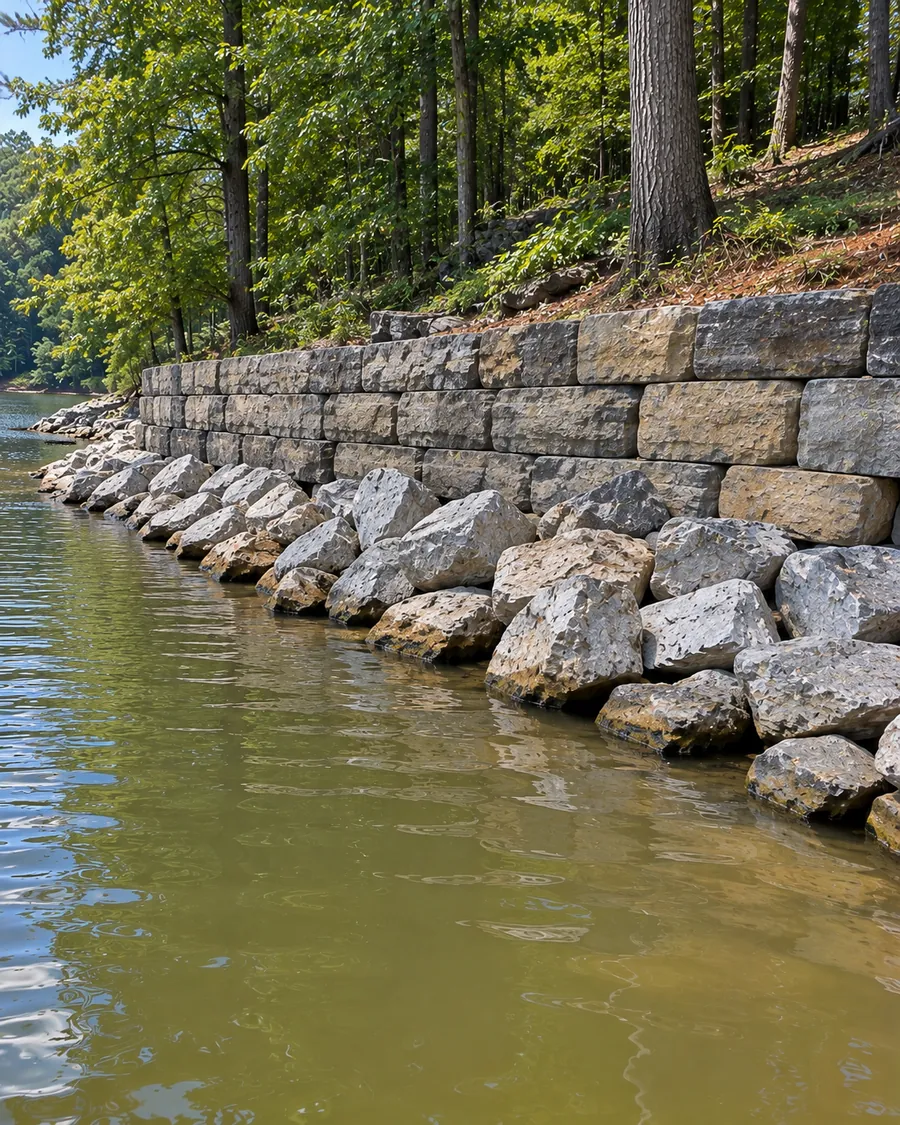
When TVA will consider a wall
Paragraph (c)(1) of 18 CFR 1304.208 gives two routes to a retaining wall on TVA-owned residential access shoreland:
- Severe erosion. The bank is eroding severely, and TVA concludes no other erosion control would work as well as a wall.
- Tying into an approved wall. The new wall would join one TVA has already approved, either on your own lot or on the lot next door.
Everything else in the stabilization rule, from planting to riprap and gabions, comes without that "severe" condition. If your bank is eroding but not severely, expect TVA to steer the project toward those methods. Shoreline erosion explains how TVA looks at a bank.
Materials TVA accepts and bans
Retaining wall materials, 18 CFR 1304.208(c)(2)
- Accepted
- Poured concrete, concrete block, stone, gabions, or another material TVA finds acceptable
- Banned
- Asphalt, brick, creosote timbers, railroad ties and rubber tires
- Broken concrete
- Banned, unless TVA judges the pieces big and sound enough to do the job
Should a quote propose a timber wall, ask exactly what lumber is planned and whether TVA will accept it, since railroad ties and creosote timbers are banned outright.
Where the wall can sit
TVA limits how far into the lake a wall can be built. The base "shall not be located more than an average of two horizontal feet lakeward of the existing full summer pool water." For reference, TVA lists Watts Bar Lake's typical summer operating range as 740 to 741 feet.
Because the limit is stated as an average, ask how the drawings will show the base's distance from the summer pool line along the whole length of the wall. Combined with the next rule, it means a wall can't be used to rebuild a yard:
Placement and footer rules, 18 CFR 1304.208(c)(3) and (c)(4)
- Lost land
- Can't be won back; the wall goes where the bank is now
- Base location
- Within an average of 2 horizontal feet out from the summer pool waterline
- Footer riprap
- Riprap 2 feet deep or more in front of the footer, to break waves and limit undercutting
TVA gives the reason for the footer stone itself: it deflects wave action and reduces the undercutting that could eventually damage the wall. That makes the riprap part of the wall design, not an extra. The wall paragraph doesn't name a stone type for the footer. TVA's riprap paragraph calls for quarry-run or natural stone and bars debris salvaged from construction sites, so ask what stone is planned. More on those rules in the riprap guide.
Fixing an existing wall
TVA's rules give some room to walls built under earlier standards, with limits. The first two points come from TVA's grandfathering section, which covers development established before November 1, 1999, along TVA-owned residential access shoreland:
- Grandfathered structures, such as retaining walls TVA permitted before that date, may keep being maintained under the requirements of their previous permit, and TVA doesn't require them to be modified to meet new standards (1304.210(a) and (b)).
- Lost to fire or a storm. TVA reissues the permit for a permitted structure that fire or storms destroyed, provided it goes back up to the specifications TVA first approved (1304.210(c)). For a wall permitted after 1999, ask TVA how a rebuild will be handled.
- Buying a lot with a wall means taking on its upkeep, and TVA's sign-off is needed for any repair that changes its size, any structural change, and anything new (1304.10(b)).
Under 1304.10(b), a repair that changes a wall's size, or modifies its structure, needs TVA approval. Find any permit for the existing wall before you call a contractor, and ask TVA how the planned work will be treated.
Permits for a wall
A wall on TVA land goes through the same Section 26a application as other shoreline stabilization, online only since October 1, 2025. TVA's fee schedule charges nothing for shoreline stabilization. Confirm with TVA that your wall is being handled under that category. TVA aims to issue minor construction permits within 100 days, with some taking up to 120.
Tennessee's ARAP program lists bank stabilization among the changes to state waters that need a permit, and TVA's FAQ says a copy of any state application must go in with your 26a application. A wall may also involve a county building permit. Roane County's Building Codes and Zoning office in Kingston (865-717-4230) enforces the 2024 International codes, but its web page doesn't mention lake walls, so call. The permits guide covers each step.
Questions for whoever builds it
- What erosion evidence will go with the application to show TVA it's severe?
- Will the drawings show the wall's base relative to the full summer pool line, and its average distance lakeward?
- What material is proposed, and is it on TVA's accepted list?
- How deep is the riprap along the footer, and what stone?
- Who designs the wall, and how is drainage behind it handled?
- What happens to the soil and vegetation behind the wall, and is TVA approval for that in the application?
- Does the price include TVA drawings, TDEC coverage and any county permit?
Seawall and retaining wall questions
Is a seawall allowed on my Watts Bar lot?
Two situations qualify: severe erosion where TVA concludes a wall beats the other options, or a wall that ties into one TVA already approved on your lot or next door.
How far out into the lake can a wall go?
Its base has to stay within an average of 2 horizontal feet lakeward of the summer pool waterline, and TVA won't let it recover ground the lake already took.
Does a wall need riprap in front of it?
Yes. TVA wants at least 2 feet of riprap depth in front of the footer.
What if a storm takes out a permitted wall?
TVA's grandfathering section, which covers development from before November 1, 1999, says the permit will be reissued if the replacement is rebuilt to the specifications TVA originally permitted. For a newer wall, ask TVA.
How this site helps
Call (865) 445-5366 or send a request with where you are on the lake and what the wall or bank looks like. One independent local contractor who works on Watts Bar Lake will follow up. The referral is free.
Related pages
Wall failing, or bank too steep for stone?
Call or send a request to reach one independent local contractor who works on Watts Bar Lake. The referral is free.