Shoreline Erosion on Watts Bar Lake: Signs, TVA's Test and Fixes
Shoreline erosion on Watts Bar Lake rarely announces itself. A bank loses a little soil with each round of waves until a lip of turf hangs over a hollow, a tree leans, or a section slumps into the water. Where that bank sits on TVA land, TVA decides whether the erosion is serious enough to approve a fix and which fix it will allow. This page covers what to look for, how TVA's test works, the repairs its rule lists, and how the winter drawdown helps you see what's happening below the summer waterline.
What wears a lake bank down
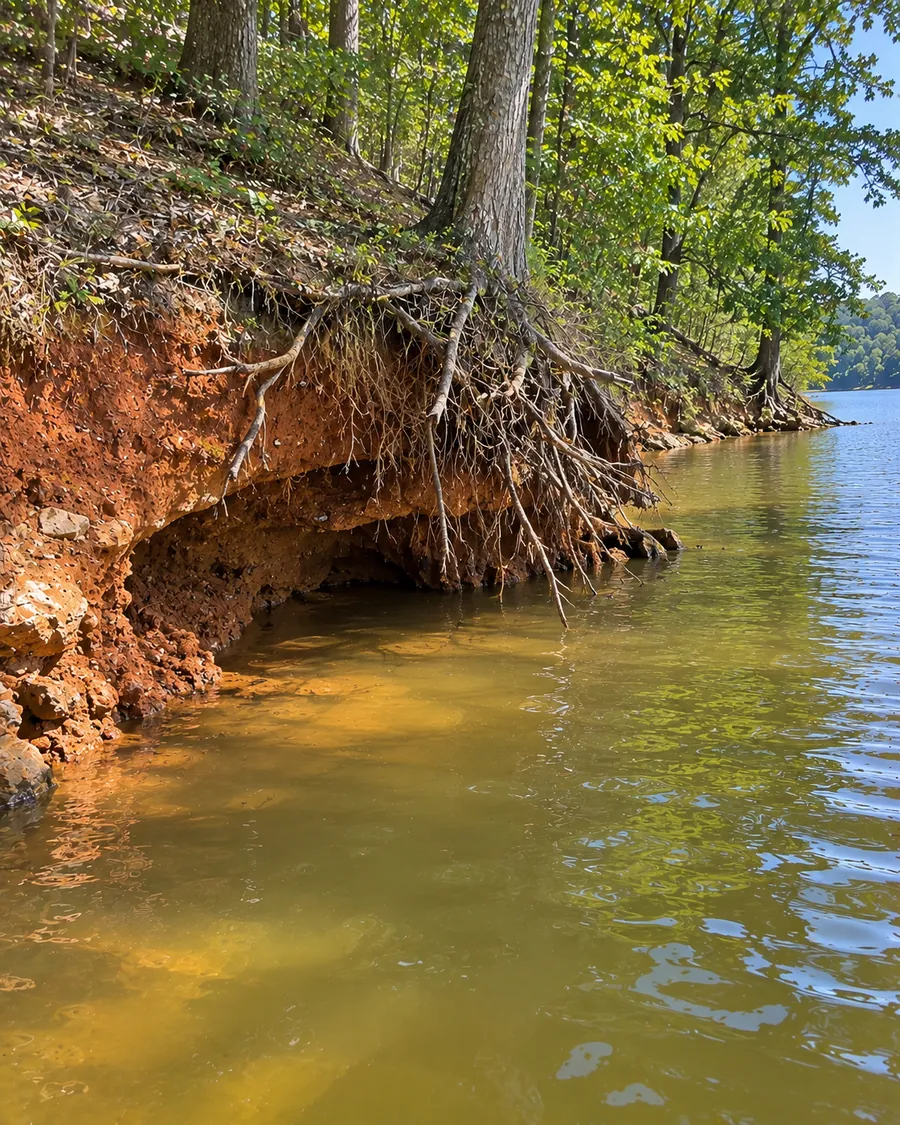
Moving water does most of the damage. Wind-driven waves and boat wakes strike the foot of the bank, pull fine soil out from under the turf and roots, and leave an overhang that eventually collapses. TVA's own rule describes the same process when it says riprap at a wall's footer is there to deflect wave action and reduce undercutting.
Two things about Watts Bar Lake shape where that happens. First, the lake doesn't hold one level: it sits around 740 to 741 feet in summer and is drawn down toward 735 feet starting November 1, so the line where waves meet the bank moves with the seasons. Second, it's a working river. Watts Bar Dam has a navigation lock, and TVA describes the reservoir as creating a slack-water channel for navigation more than 20 miles up the Clinch River and 12 miles up the Emory River.
Erosion isn't only a homeowner's problem. In April 2019 TVA completed an environmental assessment for placing rock riprap along 250 feet of island shoreline at Tennessee River Mile 548.2 in Roane County, to reduce bank erosion and the turbidity and sediment it sends into the reservoir.
Signs your bank is losing ground
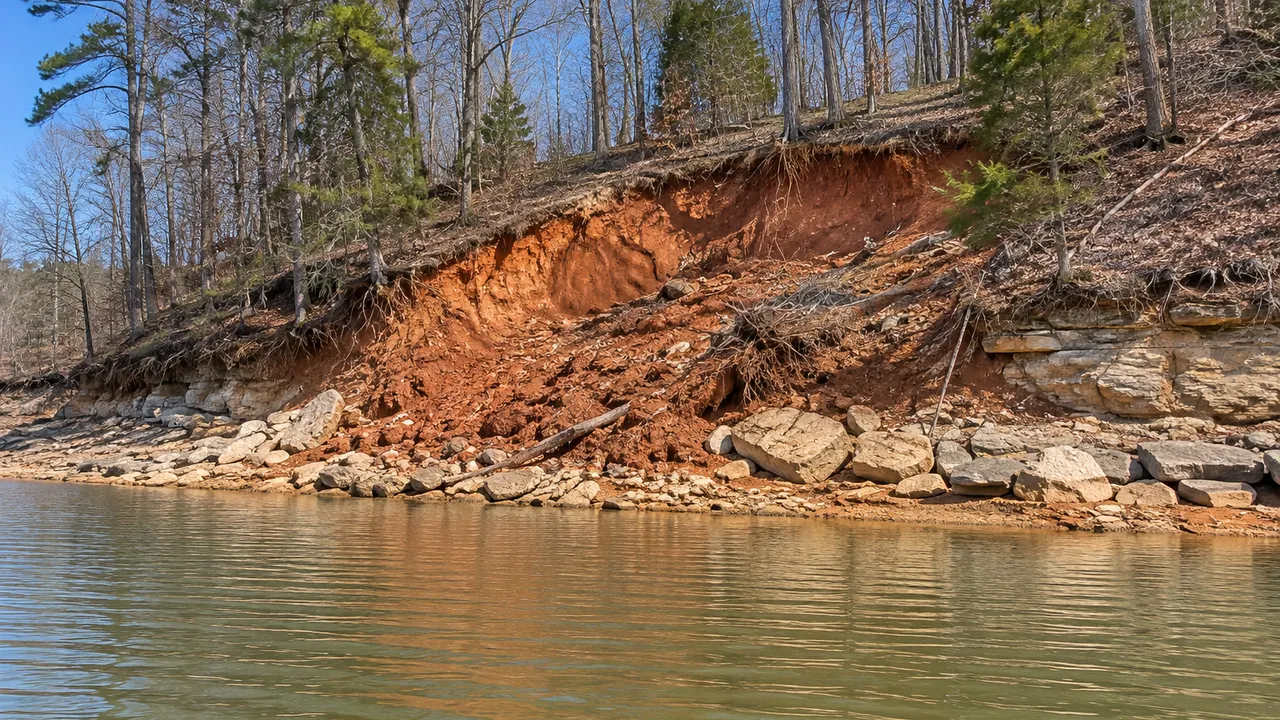
- A vertical or overhanging face at the waterline, with a hollow underneath.
- Roots hanging in the air, or trees leaning toward the water.
- Cracks in the lawn running parallel to the shore, a few feet back from the edge.
- Chunks of bank or sod lying at the base of the slope.
- Muddy water along your shore after wind or heavy boat traffic, when the rest of the cove is clear.
- Old riprap that has slid, thinned out, or left gaps where soil is washing through.
- Steps, a walkway or a dock's shore end that now sits closer to the edge than it used to.
One sign by itself may not mean much. Several together, or one that gets worse from one season to the next, is worth having someone look at.
How TVA decides whether a bank needs work
TVA's stabilization rule, 18 CFR 1304.208, lets TVA permit adjacent residential landowners to stabilize eroding shorelines on TVA-owned residential access shoreland. Before anything else, TVA has to be satisfied that the erosion is bad enough to warrant the treatment being proposed.
No numeric threshold is published. TVA looks at your site, usually in person, and judges whether the erosion is enough for the specific treatment you propose; for a wall, the rule requires severe erosion. That's why the photos in your application matter. TVA requires at least one photo of the property and says applications without photos may be returned. Close shots of undercutting, exposed roots and slumped sections, taken at both summer and winter levels if you can, do more than a single wide view.
The fixes TVA's rule allows
The rule groups shoreline stabilization into three kinds of work:
Stabilization methods in 18 CFR 1304.208
- Plant-based (biostabilization)
- Light reshaping so plants can root; rolls of coconut fiber or logs at the toe to blunt waves; willow stakes and cuttings of native species; native planting in the shoreline management zone; and stone at the foot of the bank against further undercutting
- Riprap and gabions
- Quarry-run or natural stone (or another TVA-approved material) placed to follow the existing contour, or commercially made erosion-control gabions
- Retaining walls
- Only where erosion is severe and TVA finds a wall the most effective option, or to join an existing TVA-approved wall
The middle ground is easy to miss. Because the plant-based list includes riprap along the base of the eroded area, a repair can put stone where the waves hit and plants on the slope above. The riprap guide covers the stone rules, and retaining walls and seawalls covers walls.
Plants, the shoreline zone, and TVA approval
On TVA property, TVA designates a shoreline management zone 50 feet deep, or the full TVA strip if it's narrower (1304.203). The stabilization rule allows native vegetation to be planted in that zone to help minimize further erosion.
Removing plants is a different matter. Cutting back or pulling out anything growing on TVA land takes TVA's written OK, every time, according to its FAQ. Clearing brush off the bank to "see the problem better" or to make room for equipment is work that needs approval first. TVA's FAQ says a vegetation management plan must be submitted and approved before any vegetation on TVA land is disturbed, and that the plan is part of the 26a application. The vegetation rule allows trees in the shoreline management zone to be approved for removal to make a site suitable for an approved erosion control project, and says vegetation removed for erosion control must be replaced with native species (1304.203(h) and (i)).
Use the drawdown to look
From November 1 the lake drops toward its winter minimum, five to six feet below the summer range. That uncovers the part of the bank that's underwater, and out of sight, from spring through fall. While it's exposed, it's worth checking:
- how far back the hollow under the turf goes,
- whether the toe of the bank, or of any old riprap, has washed out,
- whether stone has slid down the slope and left bare soil above it, and
- whether a wall's footer has open gaps or missing stone in front of it.
Photographs taken now and again at summer pool give TVA, and a contractor, a much clearer picture. The winter drawdown page has the lake-level details.
Erosion questions
How much erosion does TVA need to see before it approves riprap?
There's no published figure. TVA weighs each bank against the fix being asked for, usually after a site visit.
Can I clear brush off my bank so I can see the damage?
Not on TVA land unless TVA has approved it in writing first, even for trimming.
Can plants alone fix a bank?
TVA's rule lists several plant-based methods, from willow stakes to native vegetation. Whether they're enough depends on how active the erosion is. The same list allows riprap at the base of the eroded area, so plants and stone can be combined.
Will TVA let me rebuild what the lake took?
No. The stabilization rule says reclaiming land lost to erosion isn't allowed, and riprap has to follow the bank's existing contour.
How this site helps
If your bank is showing several of the signs above, call (865) 445-5366 or send a request. We'll connect you with one independent local contractor who works on Watts Bar Lake to look at it and give you a written price. The referral is free.
Related pages
Sources
- 18 CFR Part 1304, TVA's Section 26a rules (full text on tva.com)
- TVA, shoreline construction permit FAQ
- TVA, Section 26a application instructions and fees
- TVA, Watts Bar Reservoir and dam facts
- TVA, understanding the drawdown
- TVA, 250 Linear Feet of Shoreline Stabilization, Watts Bar Reservoir (EA, April 2019)
Bank getting worse each season?
Call or send a request to reach one independent local contractor who works on Watts Bar Lake. The referral is free.