
Riprap on Watts Bar Lake: TVA Rules, Stone, Permits and Cost
Riprap on Watts Bar Lake is a layer of loose rock set against an eroding bank, so wind waves and boat wakes break on stone instead of chewing into soil. On this lake the decision isn't only yours and your contractor's. The Tennessee Valley Authority (TVA) controls construction on its reservoir land through Section 26a permits, and its regulations spell out what stone is allowed, how it has to sit on the bank, and when a wall is permitted instead. This guide walks through TVA's erosion test, the rules in 18 CFR 1304.208, the TVA, Tennessee and county approvals, how the winter drawdown fits in, what the rules leave open, and the questions to settle before any rock is delivered.
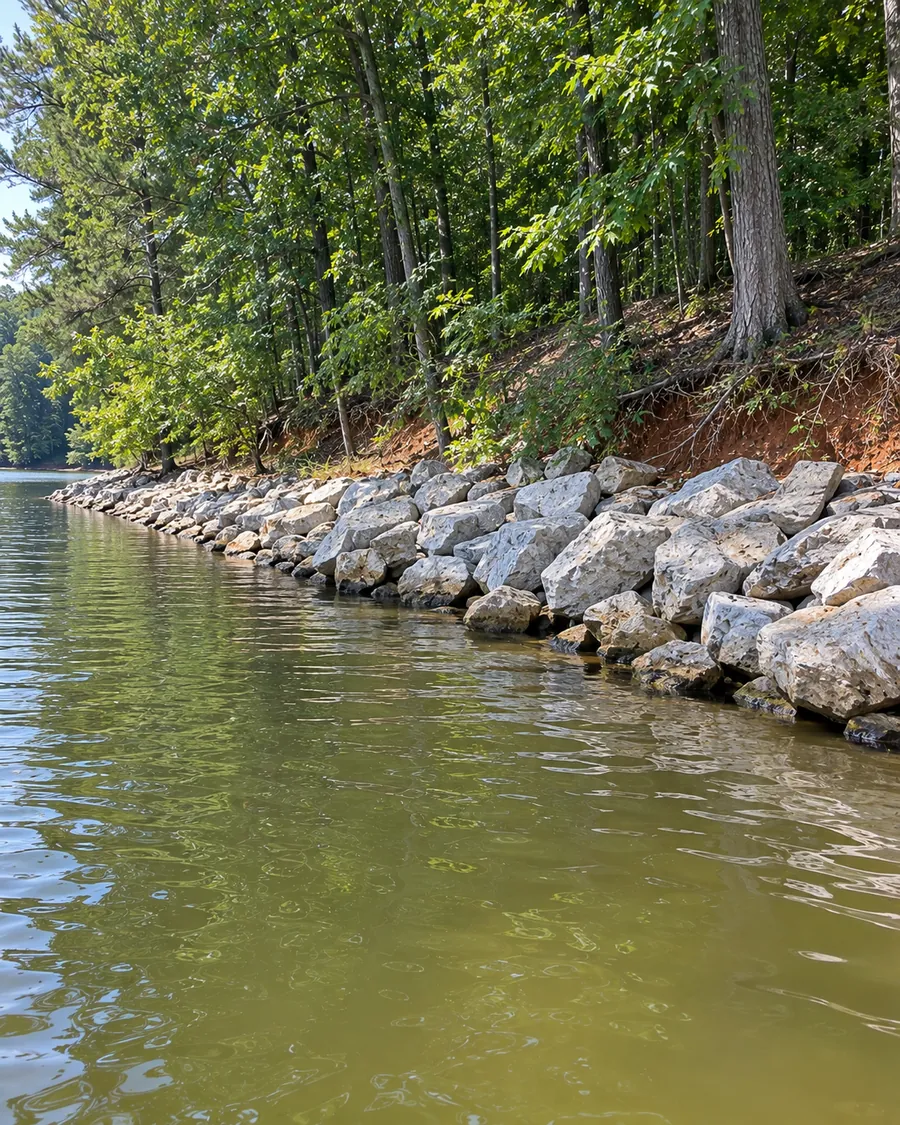
Watts Bar Lake in numbers
TVA calls the lake Watts Bar Reservoir. It's a main-river reservoir on the Tennessee River, and these are the figures that matter most for shoreline work:
Watts Bar Lake at a glance
- Water surface
- Over 39,090 acres
- Shoreline
- 722 miles
- Length
- 72.4 miles, from Watts Bar Dam northeast to Fort Loudoun Dam
- Counties
- Loudon, Meigs, Rhea and Roane, Tennessee
- Summer level
- Typically 740 to 741 feet
- Winter minimum
- 735 feet, kept for navigation
- Drawdown begins
- November 1
- TVA shoreline access land
- 2,276.4 of the 13,425 acres in TVA's land plan for the reservoir, about 17 percent
The shoreline length and the elevations come from TVA's Watts Bar page, the drawdown date from TVA's drawdown explainer, and the acreage from the reservoir's land management plan, amended in July 2021. The 17 percent is our arithmetic from TVA's two acreage figures.
Who has a say over your bank
Start by finding out who owns the strip of ground between your yard and the water, because it decides which rules apply.
- TVA land in front of your lot. TVA's stabilization section, 1304.208, applies to "TVA-owned residential access shoreland." It lets TVA issue permits to the "adjacent residential landowners" to stabilize eroding shoreline there. TVA's FAQ leaves no gray area: nothing happens on TVA land without written approval through Section 26a first, and that includes cutting back or pulling out plants.
- Your deed runs to the water. Under 1304.2(a), if a facility goes on private land, the person applying must own that land (TVA's term is the fee interest) or hold an adequate leasehold or easement interest in it. Privately owned land that carries a TVA flowage easement has its own set of sections in the regulation, the 1304.300s. This guide doesn't summarize those, so ask TVA which sections cover your parcel before anyone draws plans.
- The shoreline management zone. On TVA property, TVA designates a 50-foot-deep shoreline management zone, or the whole TVA strip where it's narrower than 50 feet (1304.203). The stabilization rules allow native plants to be added in that zone to help slow further erosion.
Your deed and plat are the place to start. If they leave it unclear where your line falls, ask TVA before anyone draws plans, since the answer changes which sections of the regulation apply.
TVA's erosion test comes before any stone
The stabilization section opens with the condition every request has to clear. In TVA's words, it "will determine if shoreline erosion is sufficient to approve the proposed stabilization treatment." There is no published threshold, such as a number of inches lost per year. TVA judges the site, and its FAQ says staff usually make a site visit as part of the review.
That puts the burden on showing the erosion clearly. TVA's application asks for at least one photo of the property and photos of existing structures, and says applications without photos may be returned. Photos that show an undercut face, roots hanging in the air, a slumped section, or soil washing into the water make the case far better than a wide view of the yard. Taking the same shots at summer pool and again during the winter drawdown shows how far up and down the bank the damage runs.
If the bank is sloped, grassy and holding, the honest answer may be that it doesn't need stone yet. Shoreline erosion on Watts Bar Lake covers how to read your own bank.
The methods TVA's rule lists
Section 1304.208 sorts stabilization into three groups. The first is biostabilization, meaning plant-based repair, and it includes:
- reshaping the bank slightly so new plants can root,
- tight rolls of coconut fiber, logs, or similar natural material laid at the toe of the damaged section to push waves away,
- willow stakes and bundles, plus live cuttings of suitable native species, worked into the eroded face,
- native plants added within the shoreline management zone, and
- stone at the foot of the eroded bank to keep it from being undercut further.
That last item matters. Stone at the toe with planting above it is a combination the rule itself describes, so a full rock blanket from the waterline to the top of the bank isn't the only design on the table.
The second group covers riprap and gabions, and the third covers retaining walls. Walls are the only method the section limits to severe erosion, which is covered further down and on the retaining walls and seawalls page.
TVA's material and placement rules for riprap
Paragraph (b) of 1304.208 is short, and every line of it should show up in a contractor's plan:
18 CFR 1304.208(b), in plain terms
- Stone
- Quarry-run or natural stone, or some other material TVA signs off on
- Not allowed
- Tires, broken-up concrete, and leftover debris from construction sites
- Gabions
- Wire-mesh rock baskets are fine if they're a manufactured erosion-control product
- Placement
- Stone follows the shape the bank has today
- Site preparation
- Only as much as the stone needs to sit at a stable slope
Two of those lines do most of the work. "Follow the existing contour" means the rock goes on the bank as it stands now. It isn't a way to push the shoreline back out, and the retaining wall paragraph says it directly: "Reclamation of land that has been lost to erosion is not allowed." The site-preparation limit means grading is allowed only to the extent the stone needs a stable slope to sit on, not to reshape the yard.
The ban on salvaged construction debris rules out the old habit of dumping broken patio slabs or block over the edge. If a quote mentions reusing concrete from a demolition, that is the moment to stop and ask questions.
What the regulation doesn't specify
Some details people expect to find in a riprap rule are not in 1304.208:
- a minimum stone size or weight,
- whether filter fabric goes under the stone,
- a required slope ratio or toe depth for riprap on its own, and
- a limit on how far riprap can extend into the lake.
The only depth figure in the section is for walls: at least two feet of riprap along a wall's footer. For a stand-alone riprap job, those design choices land on the drawings you submit, and TVA can accept them, ask for changes, or attach conditions. TVA keeps a library of example drawings for shoreline stabilization and vegetation work on its application page, which is a reasonable starting point for a contractor who hasn't drawn one for TVA before.
Ask any contractor to put stone size, fabric, the finished slope, and how far the stone reaches on the drawings, so what TVA approves and what gets built are the same thing.
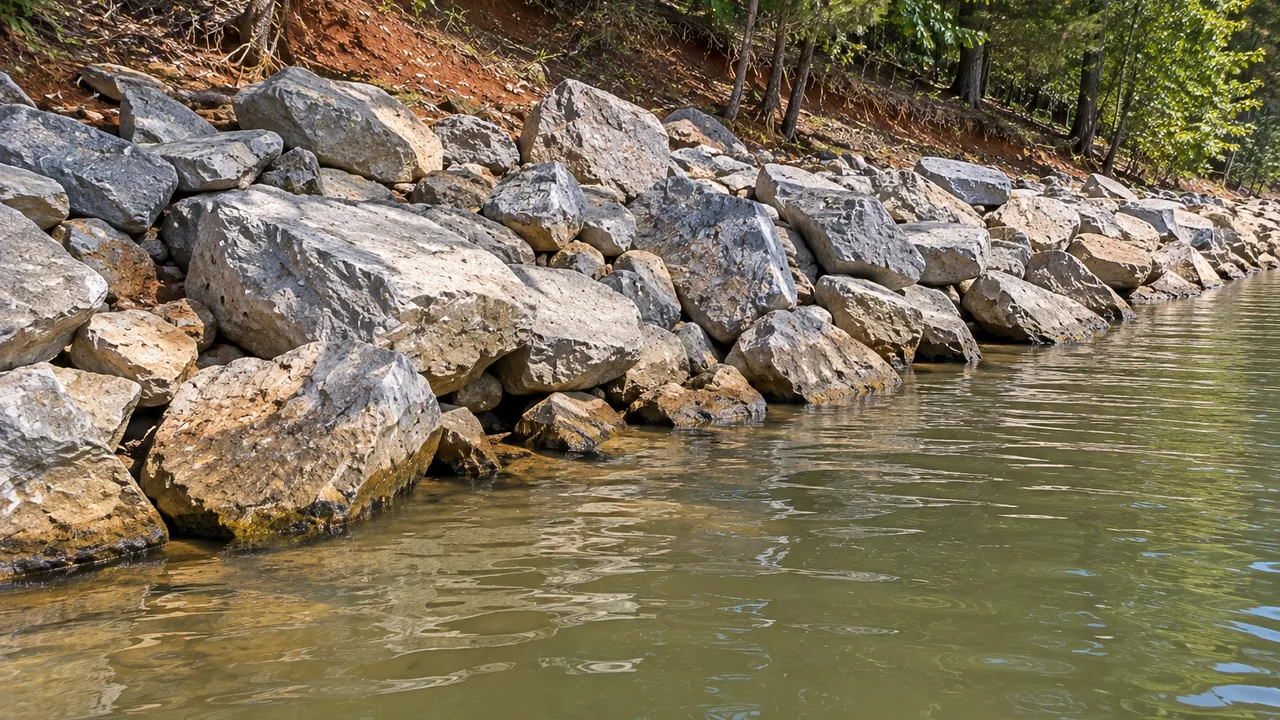
Gabions
A gabion is a wire-mesh basket filled with rock. TVA allows them for stabilization if they're commercially made for erosion control, and also lists gabions among acceptable retaining wall materials. Homemade cages or fencing wrapped around rubble don't meet that description.
When a wall comes into it
A wall needs one of two justifications: erosion severe enough that TVA rates a wall as the best control for the site, or a connection to a wall TVA has already approved, yours or a neighbor's. TVA keeps the base within an average of 2 horizontal feet of the summer pool waterline, measured lakeward, and wants 2 feet of riprap depth along the footer. Asphalt, brick, creosote timbers, tires and railroad ties are off the table, and broken concrete is too unless TVA rates the pieces big and solid enough. The full rules are on the retaining walls and seawalls page.
The approvals behind a riprap job
Riprap on Watts Bar Lake usually involves TVA, a copy to the Army Corps, the state of Tennessee, and sometimes the county. In brief:
- TVA Section 26a permit. Paper is out: TVA has taken 26a applications exclusively through its online portal since October 1, 2025. Its fee table shows "No fee" for shoreline stabilization, and TVA describes waiving fees on stabilization-only requests as its call. Expect roughly 100 days for a decision on minor construction, and as many as 120. Every applicant signs, so both spouses if both are on the deed.
- U.S. Army Corps of Engineers. TVA shares the application with the right Corps office, which for this part of East Tennessee is the Nashville District. TVA's FAQ says the Corps usually doesn't send a separate approval.
- Tennessee Department of Environment and Conservation (TDEC). Tennessee requires an Aquatic Resource Alteration Permit (ARAP) for physical changes to state waters and lists bank stabilization as an example. Its general permit GARAP001, "Repair of Eroding Banks and Shorelines," is the one written for this work. When a state permit is needed, TVA's FAQ says a copy of your application to the state water quality office (TDEC in Tennessee) must go in with the Section 26a application, and it warns that state permits required before TVA can issue its own can add delay.
- The county. Roane County's Building Codes and Zoning office is in Kingston. Its web page doesn't mention shoreline work, so call before assuming nothing is needed. Ask Rhea, Meigs or Loudon County's building office the same question if your lot is there.
Fees, file types, the GARAP001 fee schedule and contacts are on the TVA permits page.
Timing and the winter drawdown
Watts Bar Lake doesn't sit at one level all year. TVA starts the seasonal drawdown on November 1, taking the lake from its typical summer range of 740 to 741 feet toward a winter minimum of 735 feet. That's a drop of roughly five to six feet. Main-river reservoirs like Watts Bar are held lower until late April or early May, the end of the flood season, and then refill.
Lower water exposes more of the bank and its toe, which makes the condition of the shoreline easier to see, measure and photograph. Beyond that, be careful with claims that winter is the time for riprap. The stabilization section, 1304.208, sets no season for riprap, and we found no TVA statement recommending one. Your permit and any TDEC coverage can carry their own conditions, so read both before scheduling.
TVA does tie two kinds of work to the drawdown. Digging an individual boat channel on TVA residential access shoreland has to be done while the reservoir bottom is exposed and dry (1304.207(g)), and building a marine railway or concrete boat ramp "must occur during reservoir drawdown" (1304.205(a)). Neither rule is about riprap. More on the season is on the winter drawdown page.
Because TVA's review can take 100 to 120 days, an application filed in midsummer may not come back until after the drawdown has started. Plan backward from when you want the work done.
The lower lake and the Clinch River arm
One part of Watts Bar Lake has an extra layer of review. The U.S. Department of Energy says sediments in the Lower Watts Bar Reservoir and the Clinch River/Poplar Creek area contain mercury, chromium, arsenic and radionuclides. The contamination sits in deep-water sediment in the old river and creek channels, generally under 8 to 32 inches of clean sediment, and is controlled partly by restricting dredging. Dredging permit requests there are reviewed by TVA, DOE and TDEC.
DOE's page doesn't address riprap that leaves the lakebed alone. If your job involves any digging or dredging below the water on the lower lake or the Clinch arm, raise it with TVA at the start. The Clinch River arm and lower lake page has the details.
Old riprap: upkeep or a new permit?
TVA's rules don't have a line about re-setting or topping up existing riprap specifically. What they do say about permitted structures in general:
- A buyer inherits the upkeep. Section 1304.10(b) says later owners keep permitted facilities in good condition and go back to TVA before any repair that resizes a facility, any structural change, or anything new.
- Structures TVA permitted along its residential access shoreland before November 1, 1999, which TVA calls grandfathered, can keep being maintained under the requirements of their earlier permit (1304.210(b)).
Adding stone past what was there, extending riprap along more shoreline, or switching to a wall all look like changes rather than upkeep. Since the rule doesn't settle it for riprap, call TVA before new stone goes down, and keep any earlier permit for the property handy.
Getting stone to the bank
Riprap reaches a lake bank one of two ways: over land, by truck and excavator, or from the water, by barge. Which fits your lot depends on whether equipment can get down the yard, how steep it is, what's in the way, and how deep the water is off your shore at the time of the work. Land access can mean ruts in the lawn and work around septic fields, wells or utilities. Barge access avoids the yard but depends on the water.
Trees and brush matter here too. On TVA property, cutting or removing any vegetation needs TVA's written approval, so clearing a path to the water belongs in the 26a application, not in a quick afternoon with a chainsaw. TVA's vegetation rule says trees inside the shoreline management zone may be approved for removal to make a site suitable for an approved erosion control project, and that vegetation removed for erosion control must be replaced with native species (1304.203(h) and (i)).
What riprap costs
We haven't found published riprap prices for Watts Bar Lake or Tennessee. Nationally, Angi's 2025 figures run $70 to $400 for each linear foot of shoreline, about $20,000 for an average job, and $10,000 to $30,000 for a typical one. Those are national figures and local quotes vary. Local price per foot on Watts Bar Lake: [PRICE].
Permit costs are lower than people expect: TVA lists no application fee for stabilization, and TDEC's general-permit fees run from $0 to $500 depending on whether a notice is required and whether the property is a personal residence. The riprap cost page works the national range through a few shoreline lengths and lists every fee.
One more number to know: in Tennessee, a contractor license is required for projects of $25,000 or more, including just bidding or negotiating a price. Angi's typical national range of $10,000 to $30,000 straddles that line. Who does the work explains how to check a license.
Questions to settle before you sign
- Who draws the plan and elevation views for TVA, and who files the online application? Every applicant on the property, spouses included, has to sign.
- What stone is going in, quarry-run or natural, and what size? Is fabric going under it?
- How does the design follow the existing bank contour, and how much grading is planned?
- Does any tree or brush work on TVA land need approval, and is it in the application?
- Will the stone come by land or by barge, and who repairs the yard afterward?
- Is TDEC coverage under GARAP001 included in the price, along with its fee?
- What happens to the price if TVA asks for design changes?
- If the contract is $25,000 or more, what is the contractor's Tennessee license number, so you can look it up?
- Can you see a current certificate of insurance? Contractors are responsible for their own licensing and insurance.
Riprap questions on Watts Bar Lake
Is a TVA permit required for riprap on Watts Bar Lake?
Whenever the stone goes on TVA property. Nothing happens on TVA land without TVA's written approval in advance, and TVA charges nothing to apply for shoreline stabilization.
What's TVA's turnaround on a riprap permit?
Its stated goal for minor construction is 100 days, and some applications take as long as 120. Waiting on a state permit can stretch that.
Can I use broken concrete from an old patio?
Not as riprap. Broken concrete and other leftover construction debris are barred from shoreline stabilization. For walls, broken concrete is banned unless TVA finds it of adequate size and integrity.
Can riprap rebuild the yard I've lost to the lake?
No. The stone has to follow the existing contour of the bank, and TVA's stabilization rule says reclaiming land lost to erosion isn't allowed.
Does riprap have to go in during the winter drawdown?
The stabilization section sets no season for riprap. The drawdown does make the bank easier to see. Read your TVA permit and any TDEC coverage for conditions on timing.
Do I apply to the Army Corps separately?
TVA shares your application with the Corps and says the Corps usually doesn't send a separate approval. Tennessee's ARAP is a separate state permit.
How this site helps
Phone (865) 445-5366, or use the request form, and tell us roughly where you are on the lake and how much bank is washing away. We'll pass it to one independent local contractor who works on Watts Bar Lake. They look at the bank, give you a written price, and you decide. The referral costs you nothing.
Related pages
Sources
- 18 CFR Part 1304, TVA's Section 26a rules (full text on tva.com)
- TVA, Section 26a application instructions and fees
- TVA, shoreline construction permit FAQ
- TVA, Watts Bar Reservoir and dam facts
- TVA, understanding the drawdown
- TVA, Watts Bar Reservoir Land Management Plan (amended 2021)
- U.S. Department of Energy, Lower Watts Bar Reservoir and Clinch River/Poplar Creek
- TDEC, Aquatic Resource Alteration Permit (ARAP) and fees
- TDEC, list of ARAP general permits
- U.S. Army, Nashville District's regulatory role in the Tennessee River Basin
- Roane County Building Codes and Zoning
- Tennessee Board for Licensing Contractors, getting a contractor license
- Angi, riprap cost (2025 national data)
Losing ground along the water?
Call or send a request to reach one independent local contractor who works on Watts Bar Lake. The referral is free.